Connecting Badghis: Infrastructure, Economic Growth, and National Unity
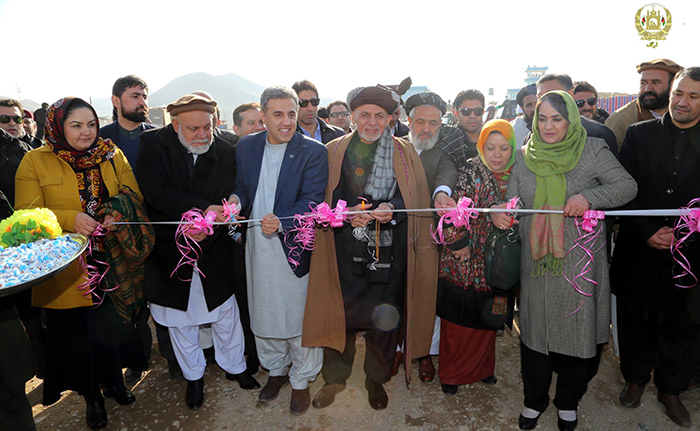
Speech at the Inauguration Ceremony of the Qaisar–Laman Road Project - Badghis
Keypoints:
- Infrastructure Development: Expanding roads to improve connectivity
- Economic Growth: Supporting trade and local markets
- Regional Integration: Linking Badghis with national transport networks
- Public Service Delivery: Improving access to services and opportunities
- Security & Stability: Strengthening state presence through development
- Local Empowerment: Creating jobs and supporting communities
- National Unity: Connecting provinces and citizens through infrastructure
Statement by the President at the Inauguration Ceremony of the Qaisar–Laman Road Project – Badghis
Key Objectives:
-
Infrastructure Development: Expanding road networks to improve connectivity and transport.
-
Economic Growth: Supporting trade and local markets.
-
Regional Integration: Linking Badghis with national transport networks.
-
Public Service Delivery: Improving access to vital services and opportunities.
-
Security & Stability: Strengthening state presence through development projects.
-
Local Empowerment: Creating jobs and supporting indigenous communities.
-
National Unity: Connecting provinces and citizens through national infrastructure
In the name of Allah, the Most Compassionate, the Most Merciful.
Honorable compatriots! Dear citizens of Badghis and especially Qala-e-Naw, respected members of the Provincial Council and the National Assembly, esteemed Ulema, civil society, dear sisters and brothers, Mr. Governor, the Commander of the Corps, the Deputy Ministers of National Defense, Interior, and National Security, Mr. Yari, Mr. Almas, Mr. Ahmadi, Professor Ghazanfar, Professor Azmoon, Mr. Baig, sisters and brothers: Peace and the blessings of Allah be upon you all!
Why is Badghis ancient? First, Badghis played a key role on the Silk Road; please, do not call Badghis "backward." Recently, I was reading the memoirs of the British delegation that was determining the borders of Badghis; they spent a year here and noted that city after city existed here before being destroyed by the Mongol invasion. Badghis was a cradle of civilization.
Second, in Dari literature, Hanzala Badghisi will always shine. Let us not forget that Dari went from Afghanistan to Iran, not that it came from Iran to Afghanistan. If you want proof, read the works of Iran's Poet Laureate, Bahar. Hanzala Badghisi laid the foundation of Dari poetry, and he was from here. The women of Badghis were influential; the mother of the Abbasid Caliph Al-Ma'mun was most likely from Badghis.
Heroes of Badghis! From Nyzak I until today, Badghis has been a land that gives birth to heroes. Therefore, today is truly a day of pride for me to be in the service of the representatives, sisters, and brothers of Badghis. First, I want to say thank you. Mr. Sangin! You gave me a title: "The Representative of Badghis." I accept it wholeheartedly! If ten provinces of Afghanistan have been deprived, I call myself their special representative. And second, I sincerely thank the honorable people of Badghis—the sisters, brothers, and all strata of society—for their continuous support of the National Unity Government. May God Almighty always keep you within the system and keep the system at your service.
Third, I thank you for your patience. When this heavy responsibility fell upon my shoulders, the problems surrounding this road were immense. A contractor had a lawsuit against us for several hundred million dollars; we defeated them in court, and God willing, we will be successful in the final stage as well. But I thank you for your patience—truly, you were patient so that we could gather the various pieces. I also thank the Asian Development Bank for agreeing to start new funding so we would not have to wait for the final legal phase. This was finalized yesterday, and I specifically express my gratitude to Mr. Ajmal Ahmadi, as he worked the hardest in the economic sector.
I want to congratulate my young and active Minister [Yari] who, just one day after receiving a vote of confidence from the National Assembly, inaugurates such a massive project. Congratulations, Mr. Yari! Since the day he entered the Ministry, all road projects have been set in motion. However, along with congratulations, there are expectations, Mr. Yari. The people of Badghis have high expectations, as does all of Afghanistan. I also want to specifically thank the sisters, the words of Ms. Shirzad, and the remarks of Mr. Aziz Baig, the honorable Chairman of the Provincial Council.
I want to classify the major issues you raised into several sections: The first is the economic transformation of Badghis. But before that: Qaisar-Laman Yuli Sizelga Qutlugh Bolsin! (May the Qaisar-Laman road be blessed upon you!) May Qaisar-Laman be blessed for all of you!
The first point is the connectivity of Badghis as a major transit province. You mentioned the road, but none of you mentioned the new project we have undertaken; by the grace of God, I will mention it. Alongside the road, God willing, in the next two years you will witness the railway passing through Badghis. I hope you followed my visit to our brother country, Uzbekistan. The biggest task we have on hand is how to connect Mazar-i-Sharif to Herat via Badghis, and this will fundamentally change the lives of Badghis and its people.
Regarding the electricity network, the final financial portion was concluded yesterday with the honorable Foreign Minister of Turkmenistan; electricity will come to you systematically and in sufficient quantity.
The management of your water is a fundamental point. I have formed a new committee to fundamentally review all dams so that within a few months, we can set the dam projects in motion. You saw that we started several major dams; our goal is to manage our 26 million cubic meters of water that today flows without management, and to become the masters of our own waters. The Tora Sheikh port is under serious work with our brother, the honorable President of Turkmenistan. We must first provide the security conditions for the Tora Sheikh port, and as soon as those conditions are met, God willing, we will see its activation.
My goal is for every border province to have a port, and Badghis is a core part of this plan. Another point I haven't mentioned, but which is necessary, is urban planning. Qala-e-Naw is not enough; its master plan must be revised. I congratulate the young Mayor of Qala-e-Naw, who is one of the eight select mayors of Afghanistan—the youngest among them—congratulations to you! I especially thank the Governor for creating an atmosphere of cooperation where all departments work systematically; I hope you have seen that in a short period, the face of Qala-e-Naw has changed.
The last time I came, there wasn't a single paved road nor 400 built shops. I congratulate the Governor, all colleagues, and especially the Badghis Department of Women's Affairs, and I am proud to inaugurate this today. However, urban planning is essential, and my directive to the Ministry of Urban Development is to start serious work on the future urban planning of Badghis. You have suffered from the "Wind of Badghis" in the past, but in the future, it can be a great blessing. The wind of Badghis is famous for being like a sword because it cuts through everything, but in the future, it can be converted into a source of energy. U.S. satellites have confirmed that Badghis and Herat are among the points in the world with the highest wind capacity; we must not forget this, as it will be utilized in the future.
The most important assets of Badghis are its forests and pistachio groves. Mr. Chairman of the Provincial Council, I assure you that we will start fundamental work in the Ministry of Agriculture on the forests, pistachios, and pine nuts so that they are protected on one hand and restored on the other. Summing up the economic section, we must develop the wealth of Badghis in terms of transit, agriculture, mining, and industry.
The port is a fundamental point, and the example I want to give is Nimroz. When I was Minister of Finance, the population of Zaranj was 8,000 people. We built the Silk Bridge and connected the road. Today, the population of Zaranj is over 250,000, and people from all 34 provinces of Afghanistan live there. Badghis must have a commercial future, and God willing, we will do fundamental work on the Tora Sheikh port and other points.
The second point is security. The Chairman of the Provincial Council was present in the security meeting. My directive to the Brigade Commander and all officials is that maintaining the current status quo is not enough. When 55 kilometers of road from Dara-e-Bum is closed and we cannot travel to several districts, we cannot call that "maintaining the status." Therefore, my clear directive is that next year cannot be a year of mere defense; next year must be transformed into a year of progress. The Deputy Minister of Defense, Mr. Helal, the Deputy of National Security, and the Deputy of the Ministry of Interior are all present, and they will create a cohesive security plan. Give me one or two months to come back with a specific plan; I have a habit of not making promises until I can act.
But in the area of security, I also want cooperation from the people. What kind of cooperation? Please, resolve the problems you have created yourselves! Not everything can be done by the state. We cannot be a Ghazi, a Martyr, and return home safe and sound with spoils all at once. If the people give me a hand, I will take six steps. If the people show me the way, I will clear it with my own hands. But it is essential that we work fundamentally on Badghis.
Participation (Masharikat) is not only discussed at the national level but also at the provincial level. All people of Badghis are included in Badghis; no person from Badghis is less than another, and no person from Badghis is superior to another. My clear directive to Mr. Baig, the Director of the Independent Directorate of Local Governance, is to fundamentally organize participation at both the national and provincial levels. Because if the people do not give a hand, what can I do? This cannot be done by force. Look at our security and defense forces too! I want to sincerely thank our security and defense forces for their bravery and sacrifice.
I tell you that our Special Forces have doubled and will continue to double; our Air Force is tripling, and resources are being provided for you. You saw that helicopters and equipment arrived; however, their management is our essential task. Regarding the Border Forces, one of the most vital issues for us and our very good neighbor Turkmenistan is the protection of this border. This border must be transformed into a border of friendship and comprehensive cooperation. I give you the good news that direct electricity from Turkmenistan will come to Khamyab, Qarqin, Torghundi, and Badghis; we will not wait for the network, this electricity will be secured. Turkmenistan is our good neighbor, but the people must be cooperative.
If we want to develop the border districts, the border must be secure. Our partner countries like Turkmenistan and Uzbekistan should not see themselves at risk, but rather see Afghanistan as an opportunity. The Public Protection sector—Mr. Yari assured me that their salaries are being processed. But a point I directed this morning: the status of contractors compared to our police and army is unacceptable. I have directed the Senior Deputy and the Security Deputy to review all contractors. If resources do not reach a location fundamentally, not only will they lose the contract, but they will never receive a contract again and will be dragged to court.
Another point is regarding human capital, from the role of women to the role of youth. Among the major tasks ahead of me are reforms in the Ministries of Education and Higher Education. The current state of education is not acceptable to me. So far, I have held at least six meetings regarding the Ministry of Education; if ten more meetings are needed before spring, I will hold them so that a reformed education system is at the service of the Afghan people. We must carry out fundamental reforms for the sake of higher education and schooling.
The current training in our schools and universities is not what the country needs, and what we need, they are not training. Unemployment is not because jobs don't exist—you bring hundreds of foreigners to give them work—it is because the training has not been done fundamentally. Therefore, I want at least one technical high school in every district of Afghanistan so we can train our children for the future. Regarding our national culture, Mr. Liwal is present; he has written several epics, and I hope the people of Badghis are included in his future epics.
In the final part, there were several specific requests: First, regarding the Women's Garden, the Governor said he would provide ten acres of land; I will provide the funding for its construction. For the Grand Mosque, Mr. Provincial Council Chairman, bring your plan for its expansion—it is accepted! And regarding the water network and the dam mentioned by Mr. Sangin and yourselves—this is also accepted! I have noted the other things carefully. I have learned one thing, Mr. Khan: if you ask for ten things and I do nine, you will hold me accountable for why the tenth wasn't done. So I have learned now; our "contract" will be that I will report back to you on every action that has been implemented.
Today, I congratulate not only the noble people of Badghis but all the people of Afghanistan. This project is one of our largest national projects. Today, Afghanistan is not connected. Look at the electricity; there are nine different grids. Without the Ring Road, Afghanistan is not connected. Our entire goal is that a single nation needs a single economy. We have shared feelings, shared history, shared religion, shared faith, and shared honor—but from an economic perspective, we are not yet connected. Therefore, it is necessary that this vital project is welcomed across Afghanistan, as it is being welcomed now. Completing it is Mr. Yari's responsibility; we want continuous reports from Mr. Yari on its completion. DABS, the Water Supply Company, the Ministry of Energy and Water, and all other ministries must perform the necessary tasks. As the "Special Representative of Badghis," a title you gave me, you must watch over these projects twice as much.