Ahmad Ali Kohzad and the Foundations of Afghanistan’s Cultural and Historical Identity
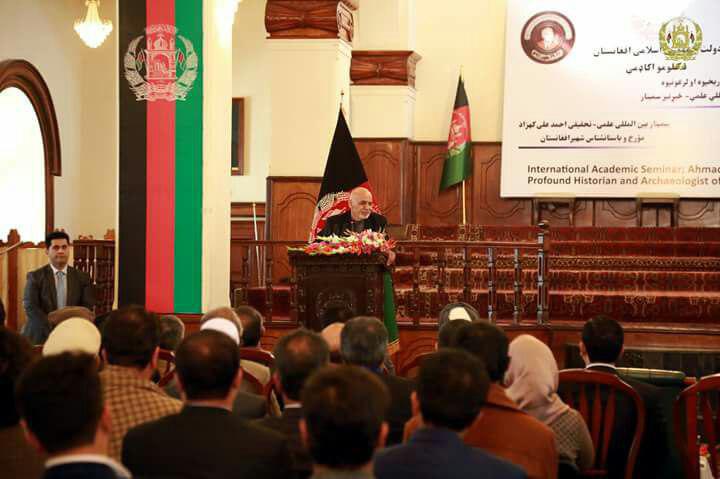
Speech at the International Scientific-Research Seminar on Ahmad Ali Kohzad
Keypoints:
- National Identity: Kohzad traced Afghanistan’s history to build unity.
- Interdisciplinary Approach: He combined archaeology, history, and literature.
- Research Rigor: His work was precise and evidence-based.
- Cultural Heritage: He preserved traditions and regional history.
- Education: He shared knowledge with students and the public.
- Global Perspective: He showed Afghanistan as a crossroads of civilizations.
- Ethics: Justice and unity guided his analyses.
- Inspiration: He motivated future generations to continue research.
In the name of Allah, the Most Gracious, the Most Merciful.
Honorable Hajji Sahib Mohaqiq, distinguished members of the Cabinet, esteemed members of the Academy of Sciences, Mr. Popal, respected professors of Kabul University and universities across Afghanistan—and especially our young students, for today is your day [International Students' Day]—and our honored guests from neighboring countries! To you all, I say: Welcome! You are most welcome! You have come upon our eyes; you have come upon our palms! May God preserve you always!
We gather today to honor the legacy of Professor Kohzad. In this discourse, we shall address three fundamental pillars: Why must we know Kohzad, and what define the hallmarks of his work? From what fountain of thought did he draw his inspiration? And finally, what is Kohzad’s message for us today—specifically for the new generation of Afghanistan?
The significance of this gathering lies in the fact that, within the discourse of an inclusive national identity, Kohzad stands as one of the most pivotal figures in our contemporary history. I wish to extend a special welcome to Mr. Homayoun Kohzad [the Professor’s son] for his presence here.
By excavating the past, Kohzad provided reasoned answers to the questions of our time regarding "national identity." By elucidating the profound interconnectedness of our cultural heritage with the region and the world, he constricted the space for the discourse of prejudice and division. He identified the historical roots of a comprehensive national identity within our unique geography.
Why Kohzad? Because he was not merely an archaeologist; he was not just a historian, a poet, or a writer. In my humble view, the most fitting title for him is "National Thinker." A national thinker because he scrutinized every facet of our national identity and provided distinct characteristics to our thousands of years of heavy history. Before Kohzad, our ancient history was myth; after Kohzad, it became a matter of scientific citation and research.
He created a historical depth for our land. In his book "What is to be Done?", Mahmoud Tarzi had but one sentence regarding our pre-Islamic history: "Whatever we were before the holy religion of Islam, we were." In the works of Fayz Muhammad Katib, and even our greatest historians, our pre-Islamic era remained legendary—there was no scientific substantiation of our ancient past. Professor Kohzad was not a mere chronicler. To me, he was the embodiment of the science of history—the science whose foundation was laid by Ibn Khaldun and which is being revived in the 21st century as disparate branches of knowledge converge once more.
Whether Professor Kohzad utilized archaeology, he utilized literary history to the same degree. If he used excavations, he equally understood historical texts. Most importantly, the vast folklore of Afghanistan flowed through his hands like a river. His motivation was to view every corner of Afghanistan with an equal eye. Whether it was the history of Bamiyan, Mirzaka in Paktia, Ghazni, Lashkargah, or Kunar—in Kohzad’s view, these were the inseparable components that link a great nation through the continuity of history.
Kohzad’s method of analysis was unique. When you examine his footnotes, you see citations from contemporary works in English, French, and Italian. His mind was not confined. The latest discoveries from Mohenjo-daro shifted his perspective, as did the findings in Babylon. His key objective was to understand how Afghanistan served as a crossroads of civilizations. Afghanistan was a country of connection, not division; a country at the cultural center, not the periphery. This was based on evidence, not mere sentiment.
He established the physical geography of Afghanistan as the common ground for Vedic and Avestan cultures. To quote the Professor:
"There is no other country in the world, save for ours, where the information of the Vedas and the Avesta both apply. Part of the Vedic information relates to Punjab; some Avestan references touch upon the lands south of the Caspian; but the territory where both apply together to complete one another is only the natural realm of our country."
He spoke of Balkh, noting that our ancient history knows no period where Balkh was not mentioned by one of its names. He spoke of Bamiyan, Ghazna, and Firoz Koh as the three centers of gravity and pillars of culture. There is no spot in Afghanistan that Kohzad did not analyze.
A Message for the New Generation
One point that carries a specific message for our youth is Kohzad’s attention to the role of women in our history. Afghan women have always shone throughout our brilliant past, and Kohzad consistently recorded their impact.
My intent is not to say his work does not require revision or further serious research. However, those who build a science leave their greatest legacy by providing a starting point for those who follow. Perhaps hundreds of books and articles are still needed to illuminate various points. Since his passing, archaeology and folklore studies have evolved; all these require fresh investigation. I hope that among the students sitting here today, young men and women will emerge who can dedicate fifty years of their lives, as Kohzad did, to the greatness of this soil and the stabilization of our national identity.
The Motivation of a Scholar
What was the impetus for his systematic work? His first memory as a student was a play in Paghman. At the end of the drama, an actor playing the role of Gharghasht stepped out and shouted before King Amanullah Khan that the people are one united nation and must stand for this homeland. Kohzad said that fifty years later, the echo of that actor’s voice still rang in his mind. This is what we call intellectual continuity and the audacity of talent.
Furthermore, his goal was to bring light to the dark corners of our history. He was a "National Thinker" because he did not keep his findings solely in academic halls. He had a regular program on Radio Kabul, publishing over a hundred articles for the general public. His audience was the Afghan nation; his audience was the schoolboy—students like me, who learned the image of and a "mad love" for this land from the Professor.
Even in his final days, while ill, research was his means of healing. He never stopped working. This is what it means to be committed to science. If we wish to revive the vision of Kabul, we must look at the texts of his books, where every garden, canal, and historic landmark was meticulously recorded.
The Message of the Late Professor Kohzad
What is the message of this for the new and contemporary generation of ours? Generally, choices are presented that are not actually choices. In what sense? That we are isolated, lost from ourselves, and merely enduring ourselves; or, that we have no history, and we must only copy and be imitators. Professor Kohzad answers you: This soil has been the manifestation of cultural creativity; it will endure for hundreds of thousands of years. And at the same time, it has been the crossroads of civilizations. In the era of the Avesta, we went from here to everywhere; six thousand years ago, we possessed international trade.
The Economic History of Afghanistan
A specific feature of Professor Kohzad that has not yet been discussed, and it is hoped that our researchers will assist in this regard, is the knowledge of economic history. I will speak of a few products of Afghanistan that the Professor established. First, Lapis Lazuli! The Professor established that in the ancient tombs of the Pharaohs of Egypt several thousand years ago, there was the Lapis Lazuli of Badakhshan. Since Lapis Lazuli is unique to Afghanistan, wherever there is Lapis Lazuli, it is a sign of trade with Afghanistan. Look at Begram. The greatest artifacts of Korea and Rome—Byzantine Rome—were found in Begram. We had an extensive trade with Rome.
Second is the horse. Afghanistan, along with our Central Asian neighbors, was one of the cradles of domesticating the horse and its trade. the largest number of horses were exported to India and China from Afghanistan. Third is the camel. Without the camel, the international trade of the Silk Road would not have existed. From this perspective, the other message of Professor Kohzad to you is that you have always been at the axis; do not move yourselves to the margins. If Afghans voluntarily want to go to the margins and if they choose the path of cultural suicide, this is in our hands; however, our historical past has been a past eloquent of connection.
Culture, Justice, and Identity
Kanishka propagated Buddhist culture from Begram and Peshawar. Zoroaster—the message of Zoroaster still resonates in the section of good and evil, and in the section of righteous deeds. Justice; the fundamental point of Professor Kohzad’s analysis of our epics is that justice was the axis of stability.
From this perspective, it is necessary that in our media and current culture, we do not honor Kohzad, the late Professor, for the sake that he was "of us," but we should honor him for the sake that he has opened the way for analysis and a discourse. In this discourse, our relations with India, China, Rome, Iran, and with everyone are raised; but we have a specific identity. The message of the Professor is this: when there was trade and cultural exchange, we had the best cooperation, and when we have come under attack, no one has left us unscathed.
Proposals and Future Initiatives
In the final part, I again thank Mr. Popal and all the colleagues of the Academy of Sciences for the trouble they have taken. First, I have a few proposals for them, and second, their own proposals.
My first proposal is that all the works of the Professor must be either printed or digitized. Likewise, all the articles that Professor Kohzad and our other professors wrote in the Kabul Yearbooks should again be either reprinted or digitized. I understand that you do not have several volumes; perhaps I have them. Since I am not in Darul Aman [the Presidential Palace], I cannot compare; but if I have the books of those years, I will place them at your service. But it is necessary that these works be collected.
The second proposal is to the universities. We only perform "dry" analysis. The best analysis is an analysis that turns into [active] analysis—what is the message of Professor Kohzad and the legacy of Professor Kohzad for us? For example, if one of the hypotheses of Professor Kohzad is proven—that Afghanistan was likely one of the first cradles of state-building in the world—this changes the entirety of archaeology and world history. This requires research and cannot take place without nationwide excavations in Balkh and Northern Afghanistan in the first part, and second in Southern Afghanistan. Therefore, my second proposal is that a delegation of Afghanistan's archaeologists be fundamentally gathered by the Academy of Sciences and universities so that the fundamental archaeological map of Afghanistan is prepared and research must be conducted.
The third proposal is regarding cultural texts. Pahlavi and Avestan texts, to the extent that they can be obtained, must be brought under analysis; because the current approach is either very optimistic or very pessimistic—which Professor Layeq will speak on—that "this is the land of others and it does not work that way!" The creation of a center in the Academy or universities for the analysis of our contemporary history is required. Our contemporary history cannot come in the form of a chronology, as a record of events. The connection of our history with our present and our future must become clear. State-building is difficult, but its path is clear. Market-building and economy-building are easy; the fundamental work is how we direct the national culture. In this discussion, all Afghans—who have both a shared pride in the past and a shared destiny in the future—must be discussed comprehensively. Fortunately, Afghanistan's [strength] is that there is no spot in Afghanistan that has not been the cradle of a state or empire; no Afghan is less than any other Afghan in any sense from a historical perspective. A discussion and discourse is necessary and, God willing, it will be arranged.
On the Proposals of the Academy
Regarding your proposals, one part concerns me, which is the naming of a crossroads; by all means! [literally: on my eyes]. The granting of the title of "Allama"; you propose it, and by all means! In the naming of the university, the universities must take part. It is an extremely useful proposal; the esteemed members of the Ministry of Higher Education and universities must decide for themselves; because this is a fundamental point. At least one of our faculties of Literature or History must be named after the Professor; this is a proposal; because the authority belongs to those who live with [his legacy] continuously. It is hoped that the Academy of Sciences moves this matter forward.
In this section, I also want to express gratitude to Professor Ghazanfar and Professor Azmoon [Presidential Advisors], who have worked hard both in theory and in follow-up. And I thank Mr. Rafiee, Mr. Sulaiman Layeq, and Mr. Zadran, who wrote articles and I had the honor of reading them that same night. I hope all attendees will benefit from them. Again, I thank you for giving me a few moments to go back to my former life. It has been approximately 27 years since I have not read books on archaeology. I read historical books every night, but I am far from archaeology; so I hope new archaeologists give me new ideas and that you gather all together.
Long live Afghanistan!